

 Posts
Posts


We have two ears and one mouth so that we can listen twice as much as we speak. - Epictetus, Greek philosopher
It has only been a few years since email and texting have dominated our communication habits. There are arguments on either side of the debate - for or against. Regardless of where you stand, it is impossible to ignore the obvious fact that texting and email has changed how we communicate. As technology continues to evolve, it will be interesting to see how our communication continues to evolve.
Despite our technological advances, one-to-one, face-to-face communication is still the foundation of our relationships with each other. Communication between spouses, peers, co-workers, or parent-to-child shares information, conveys emotions, and exchanges ideas. Healthy communication builds relationships, businesses, and communities. It is one of the pillars upon which a healthy lifestyle is built.
There are several key components to maintain healthy communication with others:
Pay attention - simple, yet increasingly more difficult in our hyper-connected world. Give the person you are speaking with your undivided attention and acknowledge the message both verbally and non-verbally. One of the most difficult parts of paying attention is genuinely listening to what is being said without mentally preparing your rebuttal or thinking about what you are going to say next.
Show that you are listening - let your speaker know you are paying attention by nodding occasionally. Smile and offer other facial expressions. Note your posture and make sure that it is open and not closed-off. You can also show that you are listening through giving your speaker small verbal cues to continue speaking.
Provide feedback - our personal filters, assumptions, judgments, and beliefs can distort what we hear. As a listener, your role is to understand what is being said. This may require you to reflect what is being said and ask questions. Reflect what has been said by paraphrasing. "What I'm hearing is..." and "Sounds like you are saying..." are great ways to reflect back. You can also ask questions to clarify certain points. "What do you mean when you say..." "Is this what you mean?"
Defer judgment - if paying attention is difficult, there are times deferring judgment can be impossible. But it is one of the most important components of healthy communication. Interrupting is a waste of time. It frustrates the speaker and limits full understanding of the message. Allow the speaker to finish. Don't interrupt with counter-arguments.
Respond Appropriately - these steps offer a model for respect and understanding. You are gaining information and perspective. You add nothing by attacking the speaker or otherwise putting him or her down. Be candid, open, and honest in your response. Assert your opinions respectfully. Treat the other person as he or she would want to be treated.
These steps should be used communicating with anyone in your life - spouse, coworker, child, friend, etc. It takes deliberate action and focus to be a good communicator.
Concentrate on your listening and remind yourself that your goal is to truly hear what the other person is saying. Set aside your thoughts and judgments in order to really pay attention to your speaker. By reminding yourself of these steps, you will become a better communicator, and will be heard by those you speak with.
Monday, July 26, 2010


Monday, July 19, 2010
Two Little Ideas That Opened the Floodgates
I'm not sure if it was hours of blueberry picking in the hot sun, or the extra barrels of blueberries I ate while we were laboring.
Maybe it was the yellow-jacket sting on my ear (yeah, that smarts - and it looks pretty funny too).
Or maybe it was the multi-page "honey-do" list I was awarded this weekend.
Whatever the reason, the cursed Writer's Block had come to rest firmly upon my shoulders.
Until The Muse arrived at the perfect time. Today he came in the form of a quick email from Seth Godin. Now, I know you may have had your fill as I have shouted my praise for Seth's work in the recommendations section of my newsletter. But I felt I owed it to you who have not read his work to share this piece, and then he will fade away from these articles, unless you ask for more.
Although a businessman and marketing expert, Seth has a great handle on the human condition and what makes us tick. His ideas here scream to be implemented in our daily lives:
The management of signals
There are two things we can get better at:
1. Getting accurate signals from the world. Right now, we take in information from many places, but we're not particularly focused on filtering the information that might be false, and more important, what might be missing.
2. Sorting and ranking information based on importance. We often make the mistake of ranking things as urgent, which aren't, or true, which are false, or knowable, when they're not. Dealing successfully with times of change (like now) requires that you simultaneously broaden your reach, focus on what's important and aggressively ignore things that are both loud and false.
Easier said than done.
I am amazed at how much insight can be packed into so few words. Here is what I took away from it:
"Accurate signals from the world" - How often do we misinterpret what we hear from those close to us? How often does a simple conversation turn into a disagreement with a loved one or someone at work, because we misread their tone, gesture, or meaning? How can we improve our communication with those important people to continuously improve our relationships with them? What other areas of our lives do we find ourselves taking in inaccurate information?
"we take in information from many places" - Take a moment to think about how many different sources of information you give your time and attention to each day: News media (tv, radio, MSNBC, CNN, ESPN, FOX NEWS), Social media (Twitter, Facebook, Linked In, Second Life, blogs), email (work, family, friends, people trying to sell you the next big thing), marketing (all those other ways you are trying to be sold the next big thing on tv, radio, billboards, text, phone, etc...) - and that's usually before you leave the house! At some point, MAYBE you have time to take in information from actual live people that you may have a deeper relationship with in a meaningful way. If you are fortunate, you may actually be able to have a conversation with the aforementioned person.
"filtering the information...what might be missing" - Do you take the time to consider the information you are receiving consciously or unconsciously? Do you ever wonder "why are they telling me this?" Do you question whether or not the information is given to you in a way that is in your best interest, or is it in somebody else's interest for you to consume that information? If the information is not good for you, who is it good for?
One of the most significant ways this realization occurred to me was in reading Dr. David Kessler's book, The End of Overeating, where he shares his interviews with food industry officials and their comments on how food is "engineered" to make us eat more, that "fat free", "sugar free", and "reduced calorie" may mean "unhealthy" and "you will eat more"; but that we are given only the information that makes it easy for us to digest.
"Sorting and ranking information" - as more and more sources compete for our attention, it's human nature to struggle to determine where our time and energy is best spent. In the end, it may come to a simple question of which is greater; consuming media or building relationships? Watch the 5th hour of programming on where a basketball player will continue his career, or play ball with the kids? Google new video of the same tragic pictures of oil flowing into the ocean, or take a drive to visit an old friend? One more episode of "The Deadliest Catch" marathon, or go fishing? It comes down to choices, your choices. And in a world where more and more people are competing for your choice in new and innovative ways, sometimes it's easy to forget you have a choice.
The final part that leapt out to me is "times of change" - really, aren't we always in a time of change? Whether it is personal or public, local or national, healthy or unhealthy, the world is always changing. You are always changing. Consciously or unconsciously; physically, mentally, emotionally, or spiritually; by choice, or by lack of choice - you change.
I've shared my thoughts on Seth's insights. I'd enjoy hearing what you think about his words. Hopefully my case of "Writer's Block" proved as insightful for you, as Seth's timely email did for me.
Maybe it was the yellow-jacket sting on my ear (yeah, that smarts - and it looks pretty funny too).
Or maybe it was the multi-page "honey-do" list I was awarded this weekend.
Whatever the reason, the cursed Writer's Block had come to rest firmly upon my shoulders.
Until The Muse arrived at the perfect time. Today he came in the form of a quick email from Seth Godin. Now, I know you may have had your fill as I have shouted my praise for Seth's work in the recommendations section of my newsletter. But I felt I owed it to you who have not read his work to share this piece, and then he will fade away from these articles, unless you ask for more.
Although a businessman and marketing expert, Seth has a great handle on the human condition and what makes us tick. His ideas here scream to be implemented in our daily lives:
The management of signals
There are two things we can get better at:
1. Getting accurate signals from the world. Right now, we take in information from many places, but we're not particularly focused on filtering the information that might be false, and more important, what might be missing.
2. Sorting and ranking information based on importance. We often make the mistake of ranking things as urgent, which aren't, or true, which are false, or knowable, when they're not. Dealing successfully with times of change (like now) requires that you simultaneously broaden your reach, focus on what's important and aggressively ignore things that are both loud and false.
Easier said than done.
I am amazed at how much insight can be packed into so few words. Here is what I took away from it:
"Accurate signals from the world" - How often do we misinterpret what we hear from those close to us? How often does a simple conversation turn into a disagreement with a loved one or someone at work, because we misread their tone, gesture, or meaning? How can we improve our communication with those important people to continuously improve our relationships with them? What other areas of our lives do we find ourselves taking in inaccurate information?
"we take in information from many places" - Take a moment to think about how many different sources of information you give your time and attention to each day: News media (tv, radio, MSNBC, CNN, ESPN, FOX NEWS), Social media (Twitter, Facebook, Linked In, Second Life, blogs), email (work, family, friends, people trying to sell you the next big thing), marketing (all those other ways you are trying to be sold the next big thing on tv, radio, billboards, text, phone, etc...) - and that's usually before you leave the house! At some point, MAYBE you have time to take in information from actual live people that you may have a deeper relationship with in a meaningful way. If you are fortunate, you may actually be able to have a conversation with the aforementioned person.
"filtering the information...what might be missing" - Do you take the time to consider the information you are receiving consciously or unconsciously? Do you ever wonder "why are they telling me this?" Do you question whether or not the information is given to you in a way that is in your best interest, or is it in somebody else's interest for you to consume that information? If the information is not good for you, who is it good for?
One of the most significant ways this realization occurred to me was in reading Dr. David Kessler's book, The End of Overeating, where he shares his interviews with food industry officials and their comments on how food is "engineered" to make us eat more, that "fat free", "sugar free", and "reduced calorie" may mean "unhealthy" and "you will eat more"; but that we are given only the information that makes it easy for us to digest.
"Sorting and ranking information" - as more and more sources compete for our attention, it's human nature to struggle to determine where our time and energy is best spent. In the end, it may come to a simple question of which is greater; consuming media or building relationships? Watch the 5th hour of programming on where a basketball player will continue his career, or play ball with the kids? Google new video of the same tragic pictures of oil flowing into the ocean, or take a drive to visit an old friend? One more episode of "The Deadliest Catch" marathon, or go fishing? It comes down to choices, your choices. And in a world where more and more people are competing for your choice in new and innovative ways, sometimes it's easy to forget you have a choice.
The final part that leapt out to me is "times of change" - really, aren't we always in a time of change? Whether it is personal or public, local or national, healthy or unhealthy, the world is always changing. You are always changing. Consciously or unconsciously; physically, mentally, emotionally, or spiritually; by choice, or by lack of choice - you change.
I've shared my thoughts on Seth's insights. I'd enjoy hearing what you think about his words. Hopefully my case of "Writer's Block" proved as insightful for you, as Seth's timely email did for me.
Monday, July 12, 2010
9 Questions to Make Your Child Listen
Our relationships with our children are a strange and mysterious journey - often with no discernable path or map, but often with the destination of "doing the right thing" to help them grow and develop in the best possible way. These relationships are filled with joy and heartbreak, sadness and elation. They are some of the longest standing, and most meaningful relationships we will have in our lives. At the end of our lives, the relationships we have with our children will be one of the most significant parts of our legacy.
Let's face it; there are times today, when we just want them to listen. At times, when we are frustrated with their choices, or their behavior, we just wish they would do as we ask. There are times, when we are at our parenting limits, that the idea of a "relationship" with our child just seems too difficult to manage, when we are just trying to manage them.
I'm here to tell you these two ideas, building a relationship with your child and managing some our more difficult times with them, are one in the same.
It starts with simple conversation. If we want them to listen to what we have to say, to behave in a manner consistent with what we ask, it helps for us to demonstrate these skills to them. One of the best ways to do this - have a conversation - a real, honest, and open conversation. Whether your child is 4, 14, or 23; or any age in between, engaging in teaches them a wealth of knowledge about how you see them, value them, love them and your relationship with them. Done right, you teach them the skill of interacting with others, and the ability to listen, even to you.
Here are nine conversation starters to get the ball rolling. A few tips when using these powerful tools: you must listen - make eye contact, give your child your undivided attention, and make sure they know you are paying attention; you can't judge their statements - this is an immediate conversation stopper for any child. Even if your child says the most outlandish thing that goes against everything you belief, judging what they say and responding with something along the lines of "that's the most ridiculous thing I ever heard," will end that conversation, and any future attempts. Instead, if your child says something you don't agree with, ask more questions, share your thoughts on the idea, continue the discussion; but don't shut them down. If you can do this, you will see your relationship grow, and watch the difficult times disappear.
The 9 Questions - adjust according to age.
1. What was the nicest thing you did for someone else today (this week, this month)? What was the nicest thing someone else did for you?
2. If you could travel to any place in the world, where would it be? What would you most like to do there?
3. If you were writing a newspaper article about your day, or year, or life, what would the headline / title be?
4. If you had $1,000,000 what would be the first thing you would buy? (a great variation on this, is to decrease the amount to $100). Another variation is to ask what your child would wish for if they were granted 3 wishes.
5. Describe your perfect day, from the time you get up, until the time you go to bed.
6. Teach me one thing you learned today that you don't think I already know. (This is such a powerful question - be ready!)
7. What movie/cartoon/comic book character would you want to be? Why? (One of my personal favorite variations - if you were a superhero, what would you superpower be?)
8. If a movie about your life was made, what actor would play you? Who would play your best friends? Who would play your family?
9. If you could ask God one question, what would it be? What do you think the answer would be?
These are just a few examples that can open up the relationship between you and your child. They are powerful tools to strengthen your relationship and to teach your child a myriad of valuable life skills. Enjoy them, and enjoy your relationship with your child!
Let's face it; there are times today, when we just want them to listen. At times, when we are frustrated with their choices, or their behavior, we just wish they would do as we ask. There are times, when we are at our parenting limits, that the idea of a "relationship" with our child just seems too difficult to manage, when we are just trying to manage them.
I'm here to tell you these two ideas, building a relationship with your child and managing some our more difficult times with them, are one in the same.
It starts with simple conversation. If we want them to listen to what we have to say, to behave in a manner consistent with what we ask, it helps for us to demonstrate these skills to them. One of the best ways to do this - have a conversation - a real, honest, and open conversation. Whether your child is 4, 14, or 23; or any age in between, engaging in teaches them a wealth of knowledge about how you see them, value them, love them and your relationship with them. Done right, you teach them the skill of interacting with others, and the ability to listen, even to you.
Here are nine conversation starters to get the ball rolling. A few tips when using these powerful tools: you must listen - make eye contact, give your child your undivided attention, and make sure they know you are paying attention; you can't judge their statements - this is an immediate conversation stopper for any child. Even if your child says the most outlandish thing that goes against everything you belief, judging what they say and responding with something along the lines of "that's the most ridiculous thing I ever heard," will end that conversation, and any future attempts. Instead, if your child says something you don't agree with, ask more questions, share your thoughts on the idea, continue the discussion; but don't shut them down. If you can do this, you will see your relationship grow, and watch the difficult times disappear.
The 9 Questions - adjust according to age.
1. What was the nicest thing you did for someone else today (this week, this month)? What was the nicest thing someone else did for you?
2. If you could travel to any place in the world, where would it be? What would you most like to do there?
3. If you were writing a newspaper article about your day, or year, or life, what would the headline / title be?
4. If you had $1,000,000 what would be the first thing you would buy? (a great variation on this, is to decrease the amount to $100). Another variation is to ask what your child would wish for if they were granted 3 wishes.
5. Describe your perfect day, from the time you get up, until the time you go to bed.
6. Teach me one thing you learned today that you don't think I already know. (This is such a powerful question - be ready!)
7. What movie/cartoon/comic book character would you want to be? Why? (One of my personal favorite variations - if you were a superhero, what would you superpower be?)
8. If a movie about your life was made, what actor would play you? Who would play your best friends? Who would play your family?
9. If you could ask God one question, what would it be? What do you think the answer would be?
These are just a few examples that can open up the relationship between you and your child. They are powerful tools to strengthen your relationship and to teach your child a myriad of valuable life skills. Enjoy them, and enjoy your relationship with your child!
Monday, July 5, 2010
Destination or Journey?
"Life's a journey, not a destination" - many wise sages throughout history and geography have made statements similar to this. I have been known to make similar statements. Until a late afternoon in June, when I thought of those wise comments and thought "What a bunch of GARBAGE!", or something very similar.
Let me share a story of how I came to this conclusion, and the wise moments during the "journey".
Camping has long been an important part of my life with friends and family. Through my time camping, I have learned of three different styles of camper, the RV camper, the car camper, and the hiker - each with their unique variations. The RV camper enjoys the luxuries of home in a large motor-driven coach, usually parked in a campground. The car camper usually throws a tent the size of a large bathroom or small living room in a car, with as many luxuries of home as can be fit into said car - cooler for beverages, grill for tasty food, etc. The hiker puts his world on his back, goes out into the woods, and "roughs it" for the sake of getting in touch with his (or her) more primal nature. Sounds pretty cool, doesn't it?
I've RV camped and car camped. I've done a lot of car camping with my family, as well as friends. Each time, we come a little bit closer to RV camping - bring along extension cords, fans, cell-phone chargers, mini-fridges... It was becoming quite embarrassing. We may as well stay at home and just leave the windows open.
So a small group of friends and I decided we wanted to "rough it". We were going to become hiker/backpackers, we were going to march into the woods somewhere and learn to live like the guys on Dual Survival, or Man vs. Wild, or Survivorman.
We took the time to do the research. We acquired the backpacks and all the things we needed to put in them. We took time to map out a route deep in the Hoosier National Forest. Then we did it. We set out for a 4-day journey in the woods.
The first night we parked out cars at a sparse horse campground and enjoyed the last cold water and small luxuries we had in our cars. We pitched our tents and had dreams of survival grandeur.
The next morning, we packed up, put our 40lb packs on our backs and started hiking into the woods. It was 85 degrees. We had planned an 8-9 mile hike to a large lake, where we would camp for the evening. We were all quite chipper about our "journey".
The "journey" was horrible. "40 lbs" is small in print, it's heavy when it's crammed on your shoulders and waist. Despite my sincerest hope, there are no escalators on the trail. But there are huge expanses of deep mud, also expanses of shallow mud, fallen trees to climb over, needle-laden branches to spike you in the face should you choose not to climb over the fallen trees, large rocks to trip you, small rocks to get in your shoes, large hills, small mountains... there are a lot of obstacles.
The one thing the trail did not have was water. Miraculously, all the streams we thought would be there were a bit dry.
Our destination was looking more and more important. Our "journey" less and less "fun".
It got rough. We soldiered on. But our spirits were falling as made the last drop in elevation to a clearing, and then the lake. The destination was heaven. Until we realized the flies bit, and the mosquitoes buzzed no matter how much DEET you thought you had on. We enjoyed the lake, as warm as it was, and filtered plenty of water to drink.
Our journey had ended, but we were miserable. This was Day 1.
We learned that the temperature had come close to 100 degrees, and that the next day, it was supposed to be worse. A heat advisory was issued. We decided we would hike back to the cars in the morning, and call an end to the trip.
We broke camp early the next day and sweat through breakfast. We hit the trail and realized that our grandparents had been right - despite my childhood giggling at their comments then, I had found it was possible to go "uphill....BOTH ways".
If the trip out was tough, the trip back was demoralizing. The "journey" was horrible. It hurt. We were fearful that "the big guy" might have to be dragged out, as every turn we took that we hoped was the parking lot, his shoulders dropped farther, and his groan of discontent was somewhat harder to hear.
Obviously we made it. We got to the nearest gas station and sat in the air-conditioning and drank more cold Gatorade than is healthy for one person to drink. We parted ways and rolled our eyes at the thought of doing it again.
Ironically, it only took 2-3 days before we started planning the next trip, seeking the next destination, hoping for a better journey.
I took some time to reflect on the entire adventure and found a lot of similarities to life that I thought would be worth sharing.
Most significantly, despite what the sages say (yes, and what I have said), life is a journey AND a destination. If it wasn't for the scenic vista at the end of the first day - the lake, water, and hammock - if it wasn't for the destination of the second day - getting to our cars, cold water, and air-conditioning; there would have been no point to the journey. The destination was the point of the journey, it was the destination we wanted to get to. There is no shame in doing it for the destination.
Of course, the cursed journey is what made such a simple destination such an amazing destination. We had been to that lake many times before, but never had we appreciated it so much. We had cold water and air-conditioning in the past, but never had we been so thankful.
Of course, when we paid attention to the journey, when we looked back on it, we learned a lot - what to take, what not to take, how to lighten our load, and to NEVER again go in the middle of June...
The journey taught us a lot about our selves, and each other; just as any journey should.
Most importantly for me, I learned that I need to seek out more destinations, because that's what makes the journey worthwhile.
I encourage you to do the same. Whether it is outdoors camping, in your professional life, or a personal goal - set a destination, plan your journey, and do it. If you have to cut your journey short, learn from it. If your journey is miserable and makes you feel like dying, pay attention to it. If your journey is sweet and easy, be thankful.
Whatever you do, however many journeys you have, continue to seek out new destinations and journey towards them.
Life has enough room for both.
Let me share a story of how I came to this conclusion, and the wise moments during the "journey".
Camping has long been an important part of my life with friends and family. Through my time camping, I have learned of three different styles of camper, the RV camper, the car camper, and the hiker - each with their unique variations. The RV camper enjoys the luxuries of home in a large motor-driven coach, usually parked in a campground. The car camper usually throws a tent the size of a large bathroom or small living room in a car, with as many luxuries of home as can be fit into said car - cooler for beverages, grill for tasty food, etc. The hiker puts his world on his back, goes out into the woods, and "roughs it" for the sake of getting in touch with his (or her) more primal nature. Sounds pretty cool, doesn't it?
I've RV camped and car camped. I've done a lot of car camping with my family, as well as friends. Each time, we come a little bit closer to RV camping - bring along extension cords, fans, cell-phone chargers, mini-fridges... It was becoming quite embarrassing. We may as well stay at home and just leave the windows open.
So a small group of friends and I decided we wanted to "rough it". We were going to become hiker/backpackers, we were going to march into the woods somewhere and learn to live like the guys on Dual Survival, or Man vs. Wild, or Survivorman.
We took the time to do the research. We acquired the backpacks and all the things we needed to put in them. We took time to map out a route deep in the Hoosier National Forest. Then we did it. We set out for a 4-day journey in the woods.
The first night we parked out cars at a sparse horse campground and enjoyed the last cold water and small luxuries we had in our cars. We pitched our tents and had dreams of survival grandeur.
The next morning, we packed up, put our 40lb packs on our backs and started hiking into the woods. It was 85 degrees. We had planned an 8-9 mile hike to a large lake, where we would camp for the evening. We were all quite chipper about our "journey".
The "journey" was horrible. "40 lbs" is small in print, it's heavy when it's crammed on your shoulders and waist. Despite my sincerest hope, there are no escalators on the trail. But there are huge expanses of deep mud, also expanses of shallow mud, fallen trees to climb over, needle-laden branches to spike you in the face should you choose not to climb over the fallen trees, large rocks to trip you, small rocks to get in your shoes, large hills, small mountains... there are a lot of obstacles.
The one thing the trail did not have was water. Miraculously, all the streams we thought would be there were a bit dry.
Our destination was looking more and more important. Our "journey" less and less "fun".
It got rough. We soldiered on. But our spirits were falling as made the last drop in elevation to a clearing, and then the lake. The destination was heaven. Until we realized the flies bit, and the mosquitoes buzzed no matter how much DEET you thought you had on. We enjoyed the lake, as warm as it was, and filtered plenty of water to drink.
Our journey had ended, but we were miserable. This was Day 1.
We learned that the temperature had come close to 100 degrees, and that the next day, it was supposed to be worse. A heat advisory was issued. We decided we would hike back to the cars in the morning, and call an end to the trip.
We broke camp early the next day and sweat through breakfast. We hit the trail and realized that our grandparents had been right - despite my childhood giggling at their comments then, I had found it was possible to go "uphill....BOTH ways".
If the trip out was tough, the trip back was demoralizing. The "journey" was horrible. It hurt. We were fearful that "the big guy" might have to be dragged out, as every turn we took that we hoped was the parking lot, his shoulders dropped farther, and his groan of discontent was somewhat harder to hear.
Obviously we made it. We got to the nearest gas station and sat in the air-conditioning and drank more cold Gatorade than is healthy for one person to drink. We parted ways and rolled our eyes at the thought of doing it again.
Ironically, it only took 2-3 days before we started planning the next trip, seeking the next destination, hoping for a better journey.
I took some time to reflect on the entire adventure and found a lot of similarities to life that I thought would be worth sharing.
Most significantly, despite what the sages say (yes, and what I have said), life is a journey AND a destination. If it wasn't for the scenic vista at the end of the first day - the lake, water, and hammock - if it wasn't for the destination of the second day - getting to our cars, cold water, and air-conditioning; there would have been no point to the journey. The destination was the point of the journey, it was the destination we wanted to get to. There is no shame in doing it for the destination.
Of course, the cursed journey is what made such a simple destination such an amazing destination. We had been to that lake many times before, but never had we appreciated it so much. We had cold water and air-conditioning in the past, but never had we been so thankful.
Of course, when we paid attention to the journey, when we looked back on it, we learned a lot - what to take, what not to take, how to lighten our load, and to NEVER again go in the middle of June...
The journey taught us a lot about our selves, and each other; just as any journey should.
Most importantly for me, I learned that I need to seek out more destinations, because that's what makes the journey worthwhile.
I encourage you to do the same. Whether it is outdoors camping, in your professional life, or a personal goal - set a destination, plan your journey, and do it. If you have to cut your journey short, learn from it. If your journey is miserable and makes you feel like dying, pay attention to it. If your journey is sweet and easy, be thankful.
Whatever you do, however many journeys you have, continue to seek out new destinations and journey towards them.
Life has enough room for both.
Monday, June 28, 2010
Be the Best
"Make the most of yourself, for that is all there is of you". - Ralph Waldo Emerson.
There is a fundamental human need in each of us to become the best we can be. To be the best "what" is often the question - the best man, best woman, best father, best mother, best wife, best husband, best business person, best doctor, best manager, best teacher, best widget maker, best cook, best tv-watcher, best athlete, best non-athlete, best whatever. Each one means something different to different people. But the fundamentals remain the same; we all have an innate drive, a motivation to strive. A desire to be the best we can be.
Abraham Maslow called it a desire for "self-actualization". You may remember reading about Maslow and his hierarchy of needs years ago in an introductory psychology class, or high school biology class. He theorized that we all have this drive towards self-actualization, but that it takes considerable work and effort to get there; after all, you don't just wake up one morning the best widget-maker or best athlete in the world, it takes time, work, education, practice, failing, doing to get there - contrary to what most 3am info-mercials may tell you....
Maslow simplified the effort to get there - to reach self-actualization - into a hierarchy of needs, a series of steps to get there; often seen as a pyramid, with each layer being a necessary foundation to achieve the next layer, or goal:
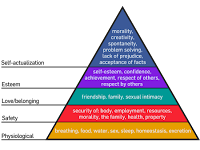
Maslow believed we must first have our basic physiological needs taken care of - do we have enough food to eat and roof over our head? If we do, we feel safe and secure and can build further security. Through the process of building security, the goal is to develop a sense of belonging - often in a family, work group, or intimate relationship. If we are able to achieve this belonging we will develop esteem, and hopefully, eventually work on becoming the best we can be, or achieve self-actualization.
His ideas continue to indicate there will be hiccups along the way - obstacles to achieving these goals - can be the cause of frustration, stress, and distress in our lives. If we are not able to have our basic human needs met, or if we cannot procure the resources needed to feel secure, we cannot move to building relationships or developing esteem. If we are unable to have healthy relationships or do not have a sense of respect for others, we will not move on towards being the best we can be.
Maslow's Hierarchy is a great tool to use to look at our selves - to determine where the obstacles might be in our lives, and how we can work to move past them.
Maslow didn't believe that many people reach the pinnacle of his pyramid. He thought the obstacles were too many, and that we were not able to overcome them to move on.
I take a different view. I believe that sometimes just knowing that self-actualization exists, and that we can achieve it, is motivating. By looking at our lives and determining where the obstacles are, we can work through them and move towards becoming the best we can be.
Where are you today in Maslow's Hierarchy? How are you moving past obstacles in your life? Are you on your way to achieving self-actualization?
There is a fundamental human need in each of us to become the best we can be. To be the best "what" is often the question - the best man, best woman, best father, best mother, best wife, best husband, best business person, best doctor, best manager, best teacher, best widget maker, best cook, best tv-watcher, best athlete, best non-athlete, best whatever. Each one means something different to different people. But the fundamentals remain the same; we all have an innate drive, a motivation to strive. A desire to be the best we can be.
Abraham Maslow called it a desire for "self-actualization". You may remember reading about Maslow and his hierarchy of needs years ago in an introductory psychology class, or high school biology class. He theorized that we all have this drive towards self-actualization, but that it takes considerable work and effort to get there; after all, you don't just wake up one morning the best widget-maker or best athlete in the world, it takes time, work, education, practice, failing, doing to get there - contrary to what most 3am info-mercials may tell you....
Maslow simplified the effort to get there - to reach self-actualization - into a hierarchy of needs, a series of steps to get there; often seen as a pyramid, with each layer being a necessary foundation to achieve the next layer, or goal:

Maslow believed we must first have our basic physiological needs taken care of - do we have enough food to eat and roof over our head? If we do, we feel safe and secure and can build further security. Through the process of building security, the goal is to develop a sense of belonging - often in a family, work group, or intimate relationship. If we are able to achieve this belonging we will develop esteem, and hopefully, eventually work on becoming the best we can be, or achieve self-actualization.
His ideas continue to indicate there will be hiccups along the way - obstacles to achieving these goals - can be the cause of frustration, stress, and distress in our lives. If we are not able to have our basic human needs met, or if we cannot procure the resources needed to feel secure, we cannot move to building relationships or developing esteem. If we are unable to have healthy relationships or do not have a sense of respect for others, we will not move on towards being the best we can be.
Maslow's Hierarchy is a great tool to use to look at our selves - to determine where the obstacles might be in our lives, and how we can work to move past them.
Maslow didn't believe that many people reach the pinnacle of his pyramid. He thought the obstacles were too many, and that we were not able to overcome them to move on.
I take a different view. I believe that sometimes just knowing that self-actualization exists, and that we can achieve it, is motivating. By looking at our lives and determining where the obstacles are, we can work through them and move towards becoming the best we can be.
Where are you today in Maslow's Hierarchy? How are you moving past obstacles in your life? Are you on your way to achieving self-actualization?
Monday, June 21, 2010
Happy Belated Father's Day
Being that we just passed Father's Day, I thought it would be a nice to offer some thoughts for all you dads out there to start preparing for next Father's Day. Here are a few interesting facts to know for Dads, Grandpa's, Soon-to-be Dads, Some-day Will Be Dad's, and all the woman who work so hard to support us in our efforts to be the best Dad we can be.
The first Father's Day was celebrated in Spokane, Washington on June 19, 1910, after Sonora Dodd, a child raised by a single father, encouraged churches to honor dads upon hearing a Mother's Day-themed sermon.
President Nixon made it an official National celebration in 1972.
Father's Day is the fifth most popular dining-out day each year - the top three winners of our business: Olive Garden, Outback Steakhouse, and Applebee's.
Did you know there are an estimated 66,000,000 fathers in the United States. Of those, approximately 158,000 are stay-at home dads - Good for you guys!
Approximately 1 in 25 men suffer from male postnatal depression - also known as "sad dad syndrome", and with good reason; added stress, concerns about being a "perfect dad", changing relationships with our wives; there are a considerable amount of new stressors added into the new dad's life; sadly, not many men seek the help they need to manage these stressors and depression.
One in four dads spend less than an hour with their kids each day. Thirty-eight percent of working dads say they would take a pay cut for more time with their children.
So what can you do with the time you DO have with your kids? Here are a few summer ideas to build your relationship with your child for moms and dads.
· Share with them your favorite sport or hobby - take them fishing and show them how to bait a hook or tie a fly, take them boating, catch a minor league ball game or go see them play in the big league. Take the time to share part of yourself, and you will build a bond with your child they will remember into their parenting years.
· Teach your child something - set a goal to teach them how to make a wooden birdhouse. If your passion is camping, teach them how to set up a tent and make a proper campfire - of course you have to teach them the finer art of smores with that! Teach her how to golf, or at least drive the cart, teach him how to change the oil - it doesn't have to be a big summer long project. But take the time to teach your child something that will help them grow, that they may not learn in school.
· Get out of town - or at least out of the house. This time of year is ripe with local, and not so local, festivals and things to do. Take in one of those pieces of America at a county fair or festival in a local town or nearby city. Get out and enjoy the State and National Park system - we are fortunate to have a great parks system with miles of trails and waterways - an amazing day is as simple as going to the front of the park and picking up a map, or looking at the day's event. You won't be disappointed.
Whatever you decide to do, do it with your child in a kind, loving, and caring manner, and you can't go wrong. Being a dad isn't easy, there is no instruction manual to tell you how to do it perfectly, but as long as you go about with the attitude of doing what is best for your daughter or son, you are going to get it right a good percentage of the time.
The first Father's Day was celebrated in Spokane, Washington on June 19, 1910, after Sonora Dodd, a child raised by a single father, encouraged churches to honor dads upon hearing a Mother's Day-themed sermon.
President Nixon made it an official National celebration in 1972.
Father's Day is the fifth most popular dining-out day each year - the top three winners of our business: Olive Garden, Outback Steakhouse, and Applebee's.
Did you know there are an estimated 66,000,000 fathers in the United States. Of those, approximately 158,000 are stay-at home dads - Good for you guys!
Approximately 1 in 25 men suffer from male postnatal depression - also known as "sad dad syndrome", and with good reason; added stress, concerns about being a "perfect dad", changing relationships with our wives; there are a considerable amount of new stressors added into the new dad's life; sadly, not many men seek the help they need to manage these stressors and depression.
One in four dads spend less than an hour with their kids each day. Thirty-eight percent of working dads say they would take a pay cut for more time with their children.
So what can you do with the time you DO have with your kids? Here are a few summer ideas to build your relationship with your child for moms and dads.
· Share with them your favorite sport or hobby - take them fishing and show them how to bait a hook or tie a fly, take them boating, catch a minor league ball game or go see them play in the big league. Take the time to share part of yourself, and you will build a bond with your child they will remember into their parenting years.
· Teach your child something - set a goal to teach them how to make a wooden birdhouse. If your passion is camping, teach them how to set up a tent and make a proper campfire - of course you have to teach them the finer art of smores with that! Teach her how to golf, or at least drive the cart, teach him how to change the oil - it doesn't have to be a big summer long project. But take the time to teach your child something that will help them grow, that they may not learn in school.
· Get out of town - or at least out of the house. This time of year is ripe with local, and not so local, festivals and things to do. Take in one of those pieces of America at a county fair or festival in a local town or nearby city. Get out and enjoy the State and National Park system - we are fortunate to have a great parks system with miles of trails and waterways - an amazing day is as simple as going to the front of the park and picking up a map, or looking at the day's event. You won't be disappointed.
Whatever you decide to do, do it with your child in a kind, loving, and caring manner, and you can't go wrong. Being a dad isn't easy, there is no instruction manual to tell you how to do it perfectly, but as long as you go about with the attitude of doing what is best for your daughter or son, you are going to get it right a good percentage of the time.
Monday, June 14, 2010
How to Get Lucky
There is a considerable amount of research being conducted lately on the concept of "Luck". From the research, it appears there are a lot of people who want to know the answer to the question, "how can I get lucky?"
The following is a synopsis of some of that research as reviewed in a recent edition of Psychology Today:
University of Hertfordshire psychologist and Author of
The Luck Factor, Richard Wiseman spent 10 years researching people's perceptions of their own luck. Over that time, he found that people who consider themselves "lucky" score higher on personality measures of extraversion. They are more likely to encounter new people more frequently in their lives, and tend to keep in touch with old friends more often. These same people tend to score higher in measures of openness and less in their tendencies towards negative emotional states like anxiety, anger, depression, and guilt.
Wiseman conducted an interesting experiment in which he offered two unique opportunities in the paths of two different people - one claiming to be "lucky", one not; he placed money on the ground, and planted a potential encounter with another person within a comfortable distance.
What were the results?
The self-labeled "lucky" person quickly noticed the cash, and struck up a conversation with the neighboring businessman; the "unlucky" person stepped right over the money, and sat quietly and sipped coffee without noticing the other person.
What does this mean for you? To be "lucky", according to the Wiseman study, is to notice good fortune everywhere through outgoing behavior and simple attentiveness to your environment. So the next time you go into that coffee shop, why not strike up a conversation with the person preparing your coffee, or the patron you see there every time you go in?
Another point in the Wiseman study is that you can increase your opportunities for good fortune by maintaining a large network of friends and acquaintances. For years, mental health research has told us that having a large social network can promote overall health, but in having a larger network, more opportunities for good fortune may come your way.
Wiseman conducted another experiment that illustrated the connecting between cognitive flexibility and luck. He gave subjects a newspaper and asked them to count how many photographs were inside - there were 43. Most of the subjects were able to find them within a few minutes.
However, they could have made the task much quicker and easier had they stopped to read the large type at the top of the second page that read "stop counting - there are 43 photographs in this newspaper; or, they could have been awarded $250 if they noted the message in the middle of the page that read "stop counting, tell the experimenter you have seen this and win $250." "Luck" in this situation, seems to be more akin to "observant".
What does that mean for you? Be flexible. Be observant. Going about tasks differently or more observantly might bring about more "luck" than you were expecting. Flexible people tend to respond to the same stimuli differently than more rigid personalities - very often leading to opportunities for chance and good fortune to factor in.
What can you do about it?
Try taking a different route to work - see what opportunities lie along a different route. Stop by an out-of-the-way place for a lunch or a cup of coffee, rather than heading over to the same place for "the usual". Switch seats on the train. Watch a new television program or radio station. Strike up a conversation. Try something new.
The answer to the question, "how can I get lucky?" seems pretty simple according to recent research:
Be flexible. Try new things. Be observant. Maintain a strong social network. Think positively. Be open to opportunities for good fortune, and good fortune will follow.
Good luck.
The following is a synopsis of some of that research as reviewed in a recent edition of Psychology Today:
University of Hertfordshire psychologist and Author of
The Luck Factor, Richard Wiseman spent 10 years researching people's perceptions of their own luck. Over that time, he found that people who consider themselves "lucky" score higher on personality measures of extraversion. They are more likely to encounter new people more frequently in their lives, and tend to keep in touch with old friends more often. These same people tend to score higher in measures of openness and less in their tendencies towards negative emotional states like anxiety, anger, depression, and guilt.
Wiseman conducted an interesting experiment in which he offered two unique opportunities in the paths of two different people - one claiming to be "lucky", one not; he placed money on the ground, and planted a potential encounter with another person within a comfortable distance.
What were the results?
The self-labeled "lucky" person quickly noticed the cash, and struck up a conversation with the neighboring businessman; the "unlucky" person stepped right over the money, and sat quietly and sipped coffee without noticing the other person.
What does this mean for you? To be "lucky", according to the Wiseman study, is to notice good fortune everywhere through outgoing behavior and simple attentiveness to your environment. So the next time you go into that coffee shop, why not strike up a conversation with the person preparing your coffee, or the patron you see there every time you go in?
Another point in the Wiseman study is that you can increase your opportunities for good fortune by maintaining a large network of friends and acquaintances. For years, mental health research has told us that having a large social network can promote overall health, but in having a larger network, more opportunities for good fortune may come your way.
Wiseman conducted another experiment that illustrated the connecting between cognitive flexibility and luck. He gave subjects a newspaper and asked them to count how many photographs were inside - there were 43. Most of the subjects were able to find them within a few minutes.
However, they could have made the task much quicker and easier had they stopped to read the large type at the top of the second page that read "stop counting - there are 43 photographs in this newspaper; or, they could have been awarded $250 if they noted the message in the middle of the page that read "stop counting, tell the experimenter you have seen this and win $250." "Luck" in this situation, seems to be more akin to "observant".
What does that mean for you? Be flexible. Be observant. Going about tasks differently or more observantly might bring about more "luck" than you were expecting. Flexible people tend to respond to the same stimuli differently than more rigid personalities - very often leading to opportunities for chance and good fortune to factor in.
What can you do about it?
Try taking a different route to work - see what opportunities lie along a different route. Stop by an out-of-the-way place for a lunch or a cup of coffee, rather than heading over to the same place for "the usual". Switch seats on the train. Watch a new television program or radio station. Strike up a conversation. Try something new.
The answer to the question, "how can I get lucky?" seems pretty simple according to recent research:
Be flexible. Try new things. Be observant. Maintain a strong social network. Think positively. Be open to opportunities for good fortune, and good fortune will follow.
Good luck.
Subscribe to:
Posts (Atom)